
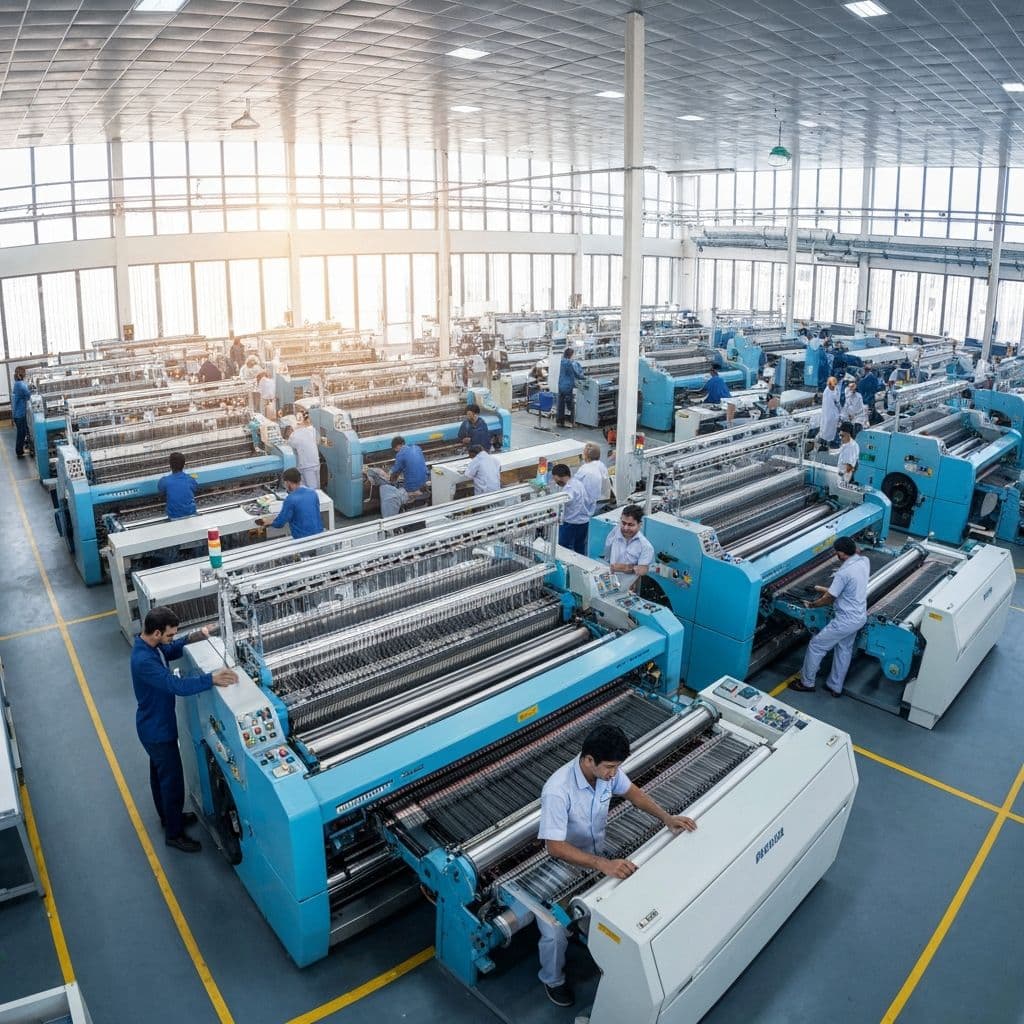
Indian Textile Market 2026
Trends, Challenges, and Opportunities in Weaving
India's textile industry in 2026 sits at a strategic crossroads. Domestic demand remains resilient, global buyers are diversifying supply chains, and policy-led infrastructure (like integrated textile parks) is pushing the industry toward larger, more efficient clusters.
At the same time, manufacturers are navigating cost pressures, compliance expectations, and the ongoing shift in fibre and fabric demand.
This blog breaks down the big 2026 trends shaping weaving in India, the challenges manufacturers are actively managing, and the opportunities emerging for mills and entrepreneurs who upgrade capacity and capability with a disciplined approach.
Quick Overview
In 2026, India's weaving landscape is being reshaped by automation, a gradual move toward man-made fibres and technical textiles, stronger focus on traceability and compliance, and policy-led investments in integrated parks. Export momentum is sensitive to global demand and trade conditions, while opportunities are rising for manufacturers who improve uptime, quality consistency, and cost per metre through modernisation and verified machine sourcing.
Where the Market Stands in 2026: Key Signals
India remains a major global player in textiles and apparel. Official releases note that textiles and apparel (including handicrafts) form a meaningful share of India's exports and that India is among the leading exporters globally. (FY 2023–24 share noted at 8.21% of total exports.)
Recent reporting also points to textile and apparel exports being broadly stable in 2025 on a calendar-year basis (around USD 37.54 billion), underscoring how global cycles and category mix influence performance.
Key Data Points (Snapshot)
| Indicator | What it suggests for weaving |
|---|---|
| Textiles & apparel share of India exports: 8.21% (FY 2023–24) | Weaving remains central to export-linked manufacturing demand. |
| Calendar year 2025 textiles & apparel exports: ~USD 37.54B | Stable exports, with shifts happening inside categories and destinations. |
| PM MITRA parks: MoUs ~₹27,434 crore+; infra works started worth ₹2,590.99 crore | Cluster-led capacity + logistics efficiency can improve competitiveness. |
2026 Trends Reshaping Weaving in India
1) Automation moves from "advantage" to "baseline"
In many clusters, weaving units are shifting toward systems that reduce manual intervention and improve consistency: better controls, monitoring, and preventive maintenance practices are increasingly normal rather than optional.
Industry perspective: "The next leg of competitiveness won't come from speed alone—it will come from stable quality, predictable uptime, and better energy discipline."
2) Fibre mix and fabric demand are evolving
Indian policy and industry commentary increasingly reflects the growing importance of man-made fibres and new-age materials alongside natural fibres. This shift impacts weaving via fabric construction choices, yarn handling requirements, and the type of loom configurations manufacturers prioritise.
3) Sustainability and compliance expectations keep rising
Buyers increasingly expect better reporting on production practices—waste reduction, energy efficiency, and traceability. Weaving units that can demonstrate process discipline often find it easier to win and retain long-term orders.
4) Clusters and parks: infrastructure becomes a competitive lever
With integrated parks and cluster development initiatives progressing, units operating within stronger ecosystems may benefit from better logistics, shared services, and access to skilled manpower over time.
Challenges in 2026: What Weaving Units Are Managing
Cost pressure: power, air, spares, and maintenance
Energy efficiency (power + air consumption) and disciplined maintenance have a direct impact on cost per metre—especially for airjet operations. Units increasingly focus on preventing downtime rather than reacting to failures.
Quality consistency at scale
As production scales, variability becomes expensive. Quality drift, yarn issues, and machine calibration gaps often translate into fabric defects and rework.
Export sensitivity to trade conditions
Exports can be sensitive to tariff environments and demand cycles. This reinforces the importance of diversification across buyers and building operational efficiency that protects margins during volatile periods.
Workforce and skill transitions
Automation changes roles rather than removing them. Teams shift from constant adjustments to supervision, troubleshooting, and planned maintenance.
Challenge vs Response
| Challenge | What strong units do in response |
|---|---|
| High downtime risk | Preventive + predictive maintenance, better monitoring, faster spares availability |
| Defects and quality variation | Calibration discipline, consistent yarn prep checks, standard operating ranges |
| Energy / air cost | Optimised settings, leak checks, upgrades that improve efficiency per pick |
| Compliance expectations | Process documentation, traceability habits, improved reporting readiness |
Opportunities in Weaving: Where 2026 Is Creating Headroom
1) Upgrading capacity without over-stretching capital
Many units are exploring verified reconditioned machines to modernise capability while controlling upfront costs— especially when machines are supported with professional inspection, warranty, and installation.
2) Higher value fabrics and better consistency
Manufacturers who improve stability and defect control can capture better realisations.
3) Better uptime as a competitive advantage
In weaving, uptime is money.
Opportunity Table: What to Invest In
| Opportunity | Practical move | Expected benefit |
|---|---|---|
| Better cost per metre | Upgrade controls + efficiency discipline | Lower running cost, higher margin resilience |
| Higher quality consistency | Process standardisation + calibration | Fewer defects, improved buyer retention |
| Capacity expansion | Verified machine sourcing + finance planning | Faster scale-up without excessive capex strain |
How Requip Helps Manufacturers Act on 2026 Opportunities
35-Point Inspection
Comprehensive quality checks
1-Year Warranty
Complete peace of mind
Free Installation
Professional setup included
1 Free Annual Service
Ongoing support & maintenance
Easy Finance
Flexible payment options to suit your budget
Frequently Asked Questions
What is the biggest trend in Indian weaving in 2026?
Operational modernisation and automation.
Are reconditioned weaving machines a good option in 2026?
Yes, when properly inspected and supported.
How can weaving units protect margins when exports become volatile?
By improving cost per metre, uptime stability, and quality consistency.